
OUR 2027 BLUEPRINT
What goes into a weekend that feels right.
When you’re absorbed in a dance, you probably aren’t thinking about the sound system, the timetable or the conversation that helped you feel at home.
We think about those things because they can make it easier to enjoy being here. This is the thinking behind MY Swing, what we learned from 2026 and what we’re working to improve for 2027.
We’re sharing it so other organisers can adapt what is useful—and share what they learn with us.
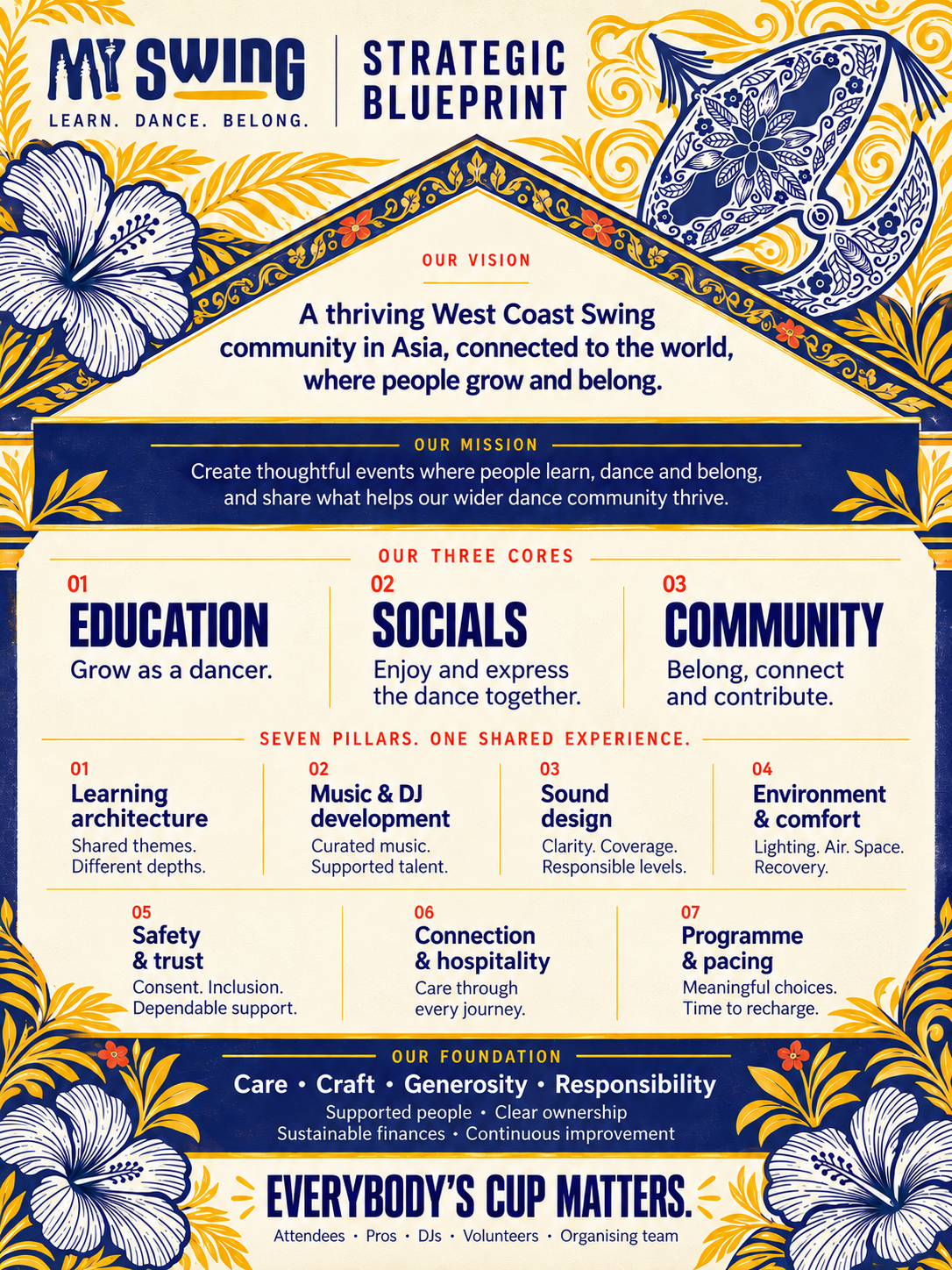
THREE CORES · ONE EXPERIENCE
What we hope you’ll
take home.
We hope you’ll leave with something new in your dancing, a few dances you keep thinking about, and people you’re glad you met.
Education, socials and community belong together. What happens in class can change a dance that evening; a friendly conversation between workshops can help you feel more at home the next day.
01 / EDUCATION
Something new in your dancing.
Explore an idea at a depth that suits you, then discover what it changes with another person.
02 / SOCIALS
A dance you keep thinking about.
Make room for music, attentive partners and the pleasure of finding something together.
03 / COMMUNITY
Someone you’re glad you met.
Let conversations and time together become part of what you take home.
Our vision, mission and foundations
Our vision. A thriving West Coast Swing community in Asia, connected to the world, where people grow and belong.
Our mission. Create thoughtful events where people learn, dance and belong, and share what helps our wider dance community thrive.
Our foundation. Care, craft, generosity and responsibility—supported by people who are cared for, clear ownership, sustainable finances and continuous improvement.
WHEN EVERYTHING CLICKS
When you’re simply
in the dance.
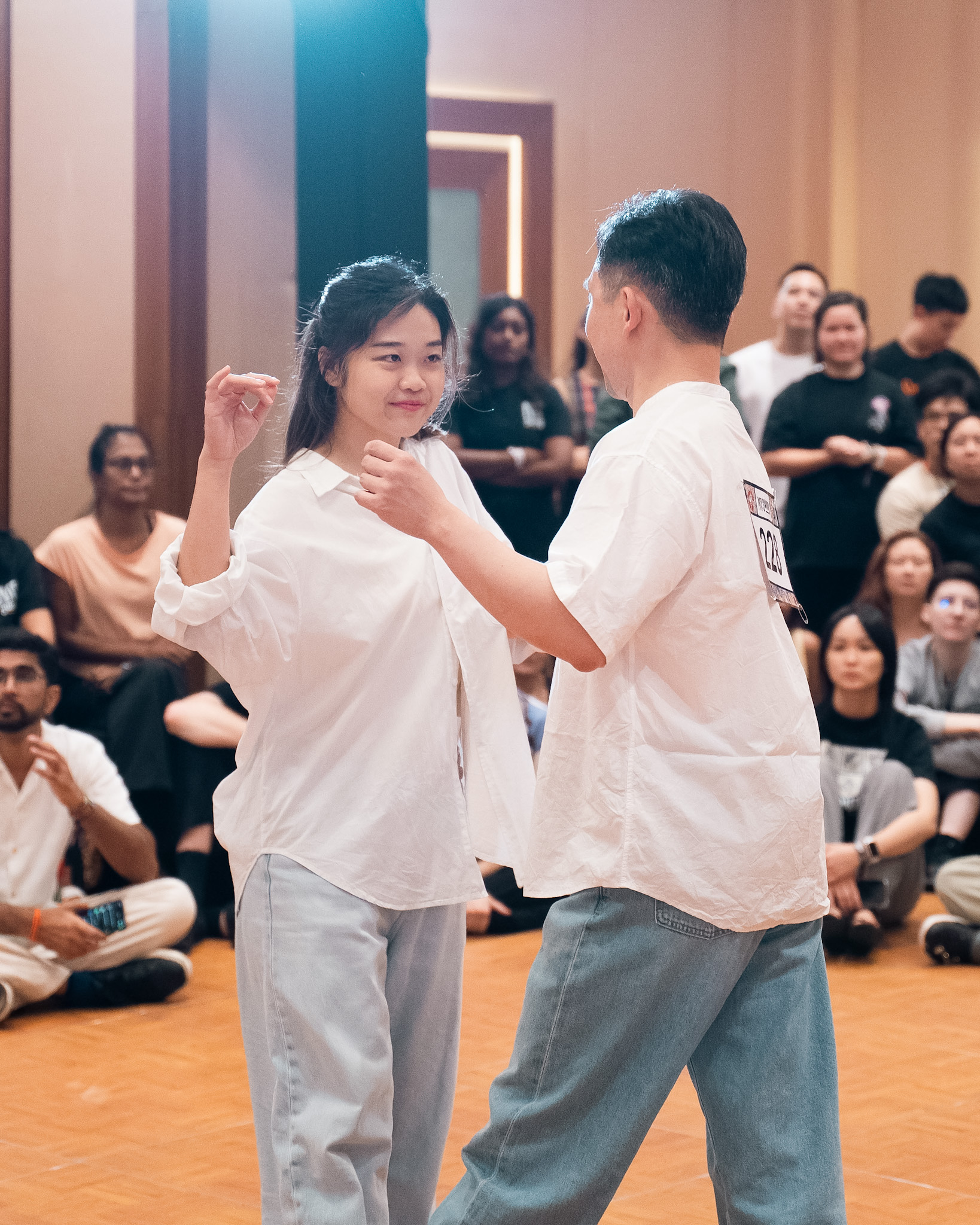
Sometimes you stop planning the next move. You hear something in the music, your partner responds, and the next moment seems to find its own way.
We can’t schedule that feeling. We can pay attention to what helps it happen: a useful challenge in class, music you can hear clearly, a comfortable room and people who respect each other’s boundaries.
That’s the purpose behind the details below.
WHAT WE’RE WORKING ON
Seven commitments
for 2027.
These are the areas we pay attention to when building the weekend. Some are established MY Swing practices; others are improvements we’re planning for 2027. Each starts with an experience we care about and the work needed to support it.
Dates, venue, teachers, workshop levels and facilities are still being finalised. We’ll share those details as they’re confirmed.
01 / LEARNING
Shared themes.
Different depths.
What you learn should help you enjoy dancing with more people.
In 2026, we worked towards shared themes across six workshop levels. For 2027, we want to plan those connections more carefully with our teachers: what each group needs, how the challenge changes with experience, and how an idea can help two people enjoy a dance together.
Our 2027 teaching plan
- Plan with the teachers. We’ll agree a few shared themes, then work out what each level needs to know, what it can explore and how the idea could help in a social dance.
- Help the idea work with different partners. Teachers will have a shared direction and room to teach in their own way. An advanced dancer should be able to use what they’ve learned to make a dance clearer and more enjoyable with a newer partner. Both people have something to offer.
- Leave time to try it. Classes will include time to use an idea in familiar dancing, with a simple takeaway for later. The social remains a place to enjoy yourself; nobody needs to have taken the class to join in.
Try this at your event. Choose one shared theme and ask every teacher: “What does this mean at this level—and how will it help a partner?”
02 / MUSIC & DJ DEVELOPMENT
Great music starts
long before the party.
A familiar song can help you settle in. A surprising one can give you a new idea. A good DJ notices what the room needs and knows when to change the mood.
We appoint our head DJ about a year ahead. They spend months listening to DJs and getting to know their strengths, so each person’s set has a place in the night.
Our 2027 DJ plan
- Keep looking and listening. We’ll seek recommendations and interest from different communities, listen to a range of sets and hear DJs live where we can. We’ll look at how they choose music, respond to dancers and prepare for a set.
- Support the person behind the booth. DJs need a clear brief, reliable equipment, agreed pay and breaks. We’ll include feedback and mentoring, with suitable opportunities for developing DJs to gain experience.
- Plan how the sets fit together. We’ll match DJs to rooms and time slots, help them hand over well and share what they’ve noticed. There should be music that welcomes people onto the floor throughout the night, with room to change course.
Try this at your event. Write a purpose for every set. Give the DJ a clear brief, reliable equipment and useful feedback.
03 / SOUND DESIGN
Feel the music.
Hear the detail.
A quieter rhythm or a small change in a song can give you something new to dance. We want you to hear those details clearly, wherever you are on the floor.
That’s why we plan sound around the room and listen from different positions, including the edges. For 2027, we’ll keep working on clear, even sound that feels good to spend time with.
Our 2027 sound plan
- Bring a sound engineer in early. We’ll design the setup for the room’s acoustics and dance-floor layout, with clear sound, even coverage and controlled bass.
- Listen where people dance. We’ll check several parts of the floor before opening and again as the room fills. DJs will have a consistent setup, clear handovers and a backup plan.
- Look after people’s hearing. We’ll monitor and manage sound levels, brief the team, arrange access to earplugs and plan somewhere to take a quieter break.
Try this at your event. Walk the whole room during a sound check. Assess what dancers hear at the edges as well as in front of the booth.
04 / ENVIRONMENT & COMFORT
A room you can
settle into.
It is easier to stay with the music when you can see your partner, move comfortably and take a proper break.
We plan the lighting alongside the floor, ventilation, seating and places to rest. We also need to keep checking how the room feels as the night changes.
Our 2027 comfort plan
- Make room for a break. We’ll plan seating for watching and conversation, plus a quieter place to take some time out. That matters for people staying offsite as well as those with a room upstairs.
- Keep checking during the event. With the venue, we’ll review the floor, room capacity, cooling, ventilation and access routes. Someone needs to be responsible for responding when a room gets crowded or uncomfortable.
- Test the lights from the floor. We’ll check them at a dancer’s eye level, avoid dazzling or rapid flashing effects and keep faces, steps and exits visible. We’ll publish the facilities once the venue is confirmed.
Try this at your event. Walk the venue as a tired first-time visitor: where would you find water, a seat, a conversation or a quiet moment?
05 / SAFETY & TRUST
Feel safe
to speak up.
You should be able to ask for less pressure, stop a dance or try something and make a mistake without being humiliated. Respect for those everyday boundaries helps people relax with one another.
Our Safety, Respect & Reporting code sets expectations for everyone, including the people who teach, organise and lead MY Swing.
Our 2027 safety plan
- Help everyone understand the boundaries. Anyone can decline or stop a dance. We’ll reinforce adapting to your partner and the space, speaking up about pain or discomfort, and offering technique advice only when invited.
- Make it clear who can help. We’ll name and brief the Safety Team, explain how to reach them through Registration or staff, and publish the dedicated reporting channel before the event. That online channel is still being prepared.
- Prepare the team to respond. Staff will be briefed on listening, privacy, conflicts of interest and who to call for help. Our planning will include physical hazards and safeguarding. Teachers will also be asked to make room for mistakes without humiliation.
Try this at your event. A code needs people behind it. Make the support route clear and rehearse what happens when someone asks for help.
06 / COMMUNITY & WELCOME
A warm welcome.
Sometimes a friendly hello is all you need. Sometimes you need half an hour on your own. We want it to be easy to find company and just as easy to take a break.
A welcome also depends on small practical things: knowing where to go, finding water, having somewhere to sit and being able to join a conversation or take a quiet break. We’re looking more closely at those details as we plan 2027.
Our 2027 welcome plan
- Help people settle in. We’ll make the next steps clear at registration, coordinate accommodation information with the venue and brief the team on welcoming people and answering their first questions.
- Give people places to meet. We’ll plan shared seating, smaller spots for conversation and places to watch, so there are easy ways to spend time with other dancers.
- Look after the basics. Someone will be responsible for checking and refilling water. We’ll share nearby food options and opening hours, and explain where to rest, how re-entry works and what you need to know before leaving.
Try this at your event. Ask “Would company help, or would you prefer some space?” A good welcome makes room for either answer.
07 / PROGRAMME & PACING
Your weekend.
Your rhythm.
You might want to explore an idea in class, spend longer at the socials or catch up with people you rarely see. A good programme leaves room for those choices—and enough time to eat, rest and get to the next room.
For 2027, we’re looking at how the pieces fit together, including protecting social time and making the schedule manageable for the people working it.
Our 2027 programme plan
- Explain the choices. Session descriptions will say who they’re for and what you’ll need to know. We’ll offer a few sample weekends, including options with more learning, more social dancing or a gentler pace.
- Allow time between things. We’ll check clashes between required activities and allow realistic time for food, getting between rooms and rest. Essential information should be easy to find whichever activities you choose.
- Protect time for social dancing. We’ll plan good dancing earlier as well as later, keep avoidable overruns out of social time and give the last night a proper closing. We’ll also check that the timetable is manageable for the people working it.
Try this at your event. Try walking through your timetable as an attendee. Is there actually time to eat, rest and get to the next room?
CARE FOR THE PEOPLE WHO MAKE IT POSSIBLE
Looking after
everyone.
The people creating the weekend need room to enjoy it too. A teacher who has time to prepare, a DJ with a clear brief and a volunteer who gets their break are all part of the experience we’re trying to build.
ATTENDEES
Help to find your feet.
We’ll make arrival information, class guidance and support easy to find, so you know where to go and who can help.
PROS
Time to prepare and recover.
We’ll look at each pro’s classes, privates, judging, rehearsals and shows together, so the workload makes sense. They’ll have agreed terms, a named contact, room support and protected time to prepare, eat and rest. Time for social dancing will be agreed with them.
DJS
The support behind every set.
Clear briefs, reliable equipment and someone to turn to for support. Our music plan explains how we’ll prepare and look after the people behind each set.
VOLUNTEERS & ORGANISERS
A festival experience of their own.
We’ll plan clear roles, training and shifts with someone ready to take over for a break. Volunteers need food, water and agreed time to enjoy the festival themselves. If something difficult happens, they should know who to call.
THE WHOLE WEEKEND
The experience starts
before the first dance.
Finding your way to the venue, knowing what happens next and having somewhere to pause all affect how you feel when you reach the floor. We’re thinking through the visit from the first booking questions to the journey home.
01 / BEFORE YOU ARRIVE
Know what you’re booking.
We’ll explain pass inclusions and class levels, share travel, accommodation and access information, and give you a way to ask questions.
02 / THROUGH THE DOOR
A welcome and a little help.
We’ll make directions and next steps clear at registration, and check hotel arrival times, luggage arrangements and early-arrival information with the venue.
03 / BETWEEN SESSIONS
A proper chance to pause.
We’ll allow time to eat and move between sessions, with places for company or a quieter break.
04 / INTO THE SOCIAL
Settle in at your own pace.
We’ll look after the music and make it easy to find a seat, water or someone who can help. You’re welcome to watch for a while or head to bed when you’ve had enough.
05 / LAST DANCE TO HOME
Before you head home.
We’ll share closing and departure information and explain how to reach us afterwards about lost property or concerns. We’ll also ask how the weekend was for you.
Accommodation and transport options will depend on the venue and providers. We’ll explain what’s available and who to contact, including if you’re local or staying elsewhere.
BEHIND THE SCENES
How we’ll
follow through.
Care needs someone to act on it. Each area needs a responsible person, enough time and a realistic budget. We want the team to notice when something needs attention and know who can put it right.
BEFORE THE FESTIVAL
Get the team ready.
We’ll give each area a lead and backup, a brief and a budget. We’ll check workloads, test the venue and sound, and walk through arrivals, handovers and requests for help.
DURING THE FESTIVAL
Keep talking to each other.
Short team check-ins will help us spot a room that needs attention, water that needs refilling or someone who’s missed a break. The person responsible needs the authority to sort it out.
AFTER THE FESTIVAL
Ask what we can do better.
We’ll ask attendees, pros, DJs and volunteers what worked and what didn’t. Did you feel welcome and safe? Were the classes right for you? Could you get enough rest? We’ll use those answers to decide what to change and share what we learn.
FOR OTHER ORGANISERS
Sharing what
we’re learning.
We’ve learned a lot from other organisers, teachers, DJs and community leaders. If something here helps your community, please use it.
Start with what fits: one shared workshop theme, a clearer DJ brief or a volunteer who can take their break. We’re still learning too, and we’d love to hear what you discover.
LET’S LEARN FROM EACH OTHER
What would make
MY Swing better?
Tell us about a moment that worked well, something that got in the way or an idea your community has tried. Those details help us decide what to improve.

